Why Single Sign-On (SSO) Matters for Modern Parking Management Platforms

How centralized authentication, multi-factor authentication (MFA), and identity governance help protect modern parking enforcement, permitting, citation processing, and government payment systems.
By: Rushi Munipalle, Principal Software Architect, Park Loyalty
In the parking industry, technology sits at the intersection of public service, payments, enforcement, permitting, customer experience, and compliance. Park Loyalty platforms do more than just process transactions—they protect access, strengthen accountability, and support the security expectations of state and local government agencies we serve. As those responsibilities continue to expand across increasingly connected systems, Park Loyalty recently implemented a centralized Single Sign-On (SSO) authentication model across our product ecosystem.
As parking enforcement software and government-facing parking management platforms become increasingly connected, cybersecurity and identity management have become foundational operational priorities.
Modern parking platforms now play a deeper role in enforcement, processing, permitting, and government integrations, making identity security foundational to our overall security posture. Single Sign-On, commonly known as SSO, provides a stronger, more consistent, and more scalable foundation for managing user authorization across our applications.
What Is SSO?
Single Sign-On allows users to authenticate once through a centralized identity provider, then access all authorized applications without managing separate credentials. For Park Loyalty, this means users can access products such as Enforce Pro, Process Pro, and Permit Pro through a unified authentication experience. Instead of managing isolated login systems across different applications, authentication is consolidated, monitored, and governed through a single identity layer.
This may sound straightforward, but in a government-facing environment, SSO runs far deeper than convenience. It is a security control, an operational improvement, and a compliance enabler.
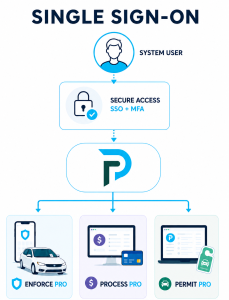
The Role of SSO in the Parking Industry
Parking technology is no longer a simple back-office function. Modern parking platforms manage sensitive operational workflows, including citation issuance, adjudication, permits, payment processes, officer activity, registered owner information, and integrations with third-party agencies and vendors.
When state and local governments rely on these systems, they expect clear guardrails around who has authorization, how permissions are granted, and how they are revoked.
SSO creates a consistent and auditable authentication process. Every login flows through a unified system where policies can be enforced uniformly across all applications. This eliminates fragmented governance and gives administrators visibility into user activity—reducing operational risk while strengthening oversight.
In practical terms, this means stronger safeguards for municipalities, parking authorities, universities, hospitals, enforcement teams, and other organizations that rely on Park Loyalty’s software.
Key Benefits of SSO
Stronger Authorization Governance
Centralized identity management ensures password policies, multi-factor authentication, session controls, and user lifecycle rules are enforced consistently across every application. For organizations handling public-sector data and payment workflows, this uniform governance is critical. Security teams gain confidence that authorization is controlled the same way everywhere, not managed differently from one product to another.
Mandatory Multi-Factor Authentication
One of the most powerful advantages of centralized authentication is the ability to require multi-factor authentication (MFA) across the entire platform ecosystem.
MFA adds a verification step beyond passwords. Even if credentials are compromised, attackers still need the second factor to gain access—a proven defense against phishing, credential stuffing, and social engineering. In an environment where AI-assisted attacks continue to increase in sophistication and scale, MFA is one of the most effective ways to reduce account takeover risk.
Faster User Provisioning and Deprovisioning
Government teams change constantly: officers, supervisors, administrators, hearing officers, finance users, customer service staff, contractors, and vendor users all need different permission levels.
Centralized identity management lets administrators grant and revoke permissions from one place. When a user joins, changes roles, or leaves an organization, there is a single source of truth. For example, when an enforcement officer leaves an agency or a contractor’s engagement ends, administrators can immediately revoke access across all connected applications from a centralized location. This reduces the risk of orphaned accounts remaining active inside individual applications—a critical gap in distributed systems.
Improved Auditability
Auditability is essential for compliance, security reviews, and incident response. Centralized authentication enables clear visibility into login history, user behavior patterns, and anomalies—and lets organizations demonstrate that safeguards are operating as intended. This is especially important for organizations that must satisfy internal security policies, PCI compliance expectations, cyber insurance requirements, and vendor risk assessments.
Better User Experience
Security measures fail when users can’t adopt them effectively. SSO removes login friction by consolidating authorization into a single, secure entry point. Instead of managing multiple credentials, users authenticate once and gain seamless access to all systems. For enforcement officers, administrators, and operations teams who depend on parking systems throughout the day, this streamlined experience directly supports productivity while reducing the temptation to reuse passwords, write them down, or create weak credentials.
Strengthening the Broader Security Foundation
SSO is most effective as part of a comprehensive security strategy. At Park Loyalty, it works alongside access reviews, role-based permissions, audit logging, application security testing, network protections, encryption, and secure development practices.
The goal is not simply to make login easier. The goal is to embed resilience into every layer of the platform—ensuring that identity, authorization, and accountability are built into the foundation of the system.
For the parking industry, this is especially important because our systems are deeply connected to public trust. Every citation, permit, payment, appeal, and enforcement action depends on the integrity of the platform behind it.
The AI-Enabled Threat Landscape
The security landscape is evolving faster than ever. AI tools now enable attackers to generate convincing phishing emails, automate social engineering campaigns, analyze leaked credentials, and scale attacks with unprecedented speed and personalization. Attackers can mimic writing styles, reference real workflows, and target specific users far more effectively than traditional methods allowed.
This creates a new reality for industries that work closely with government agencies: identity security must evolve alongside the threat environment.
In the past, phishing campaigns required time and skill to craft believably. Today, AI can generate personalized messages that reference organizational workflows, appearing legitimate to users who are not expecting the attack.
AI-assisted phishing campaigns increasingly target organizations handling payment systems, operational data, and government workflows because attackers know users rely on these systems daily. That makes centralized identity safeguards more important than ever.
SSO combined with MFA and strong monitoring significantly reduces the impact of AI-assisted attacks—stolen passwords become far less valuable. Security teams also gain a single vantage point to enforce policies consistently, detect anomalies, and respond to threats in real time. This unified approach is far more resilient than trying to defend multiple isolated systems.
Security Expectations for State and Local Government Partners
State and local governments depend on vendors that can demonstrate maturity, consistency, and accountability. Security is no longer just an IT concern—it shapes vendor trust, public confidence, and operational continuity.
Centralized identity management is also becoming increasingly important during vendor security reviews, procurement evaluations, and cyber insurance assessments.
By implementing centralized authentication, Park Loyalty reinforces a security-first approach aligned with government expectations. Unified identity management helps agencies feel confident that authorization is controlled, monitored, and governed consistently across the platform.
For government clients, this means stronger protection of operational systems. For users, it means a simpler and more secure login experience. For Park Loyalty, it means a more scalable foundation as our products and partnerships continue to grow.
Preparing Parking Technology for the Next Generation of Cyber Threats
The move to Single Sign-On is an important milestone in Park Loyalty’s investment in security, compliance, and platform maturity.
As the parking industry becomes more connected, more data-driven, and more reliant on digital systems, identity security must remain at the center. SSO reduces risk, improves oversight, strengthens governance, and prepares organizations for a future where AI will influence both cyber threats and cyber defense.
For Park Loyalty, this is about more than streamlining authentication. It’s about embedding security into every layer of the platform—and reinforcing the foundation of trust that state and local government agencies depend on.
About the Author: Rushi Munipalle, Principal Software Architect, Park Loyalty
 Rushi has been with Park Loyalty since its inception. As Principal Software Architect, he leads development, design and maintenance across frontend, backend, mobile and system administration teams, while serving as a key liaison between customer success and engineering. He also contributes to strategic product and platform development alongside the executive team.
Rushi oversees security and compliance initiatives across the organization, helping ensure adherence to PCI standards, platform reliability and secure development practices. His understanding of parking operations and agency workflows has supported innovative proof-of-concept projects focused on enforcement and analytics technologies.
A Virginia Tech graduate with a Master’s in Computer Science, Rushi has earned multiple hackathon awards, including recognition from Google, along with Park Loyalty Innovation and MVP awards.